Uriah Daugaard — computational ecologist and bioinformatician. PhD in ecology (UZH), MSc in biostatistics. Microbiome pipelines, modelling and forecasting.
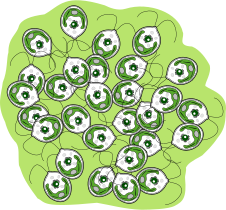
C. reinhardtii aggregateD. nasutum · D. campylum · C. striatumBacterial community
Uriah Daugaard
bioinformatics · ecology · pipelines
PhD in Ecology·MSc in Biostatistics
My work spans bioinformatics, microbiome biology, ecological modelling
and forecasting, statistics and machine learning. I turn sequencing and time series
data into models of how living systems behave.
a short bio
I work as a computational ecologist at Cybiome (Basel, Switzerland), where I build bioinformatics pipelines and predictive models for microbiome questions.
Before that I did a PhD in ecology at the University of Zurich (Petchey lab) with a thesis on ecological forecasting, an MSc in Biostatistics at UZH, and a BSc in Biology and Environmental Sciences.
Limberger R., Daugaard U., Choffat Y., Gupta A., Jelić M., Jyrkinen S., Krug R.M., Nohl S., Pennekamp F., van Moorsel S.J., Zheng X., Zuppinger-Dingley D. & Petchey O.L. Mixed evidence for species diversity affecting ecological forecasts in constant versus declining light. Global Change Biology, 31, e70364.joint first
Daugaard U., Merkli S., Merz E., Pomati F. & Petchey O.L. The dependence of forecasts on sampling frequency as a guide to optimizing monitoring in community ecology. Ecosphere, 15, e4786.
Daugaard U., Munch S., Inauen D., Pennekamp F. & Petchey O.L. Forecasting in the face of ecological complexity: number and strength of species interactions determine forecast skill in ecological communities. Ecology Letters, 25, 1974-1985.